
Retro Brawl Classic Maps Explained
Retro Brawl Classic Maps
Retro Brawl is a popular game among players who enjoy having an old-school brawler experience. The most interesting part of this game is its classic map, which, contrary to modern ones, focuses on fundamental aspects of the game rather than on multiple mechanics.
While classic maps still involve brawlers, movement, obstacles, open lanes, walls, or bushes, the most critical information about a map is its layout. Knowing a map’s details is essential the same way as brawler selection; a good player knows where to move, attack, push, or roll.
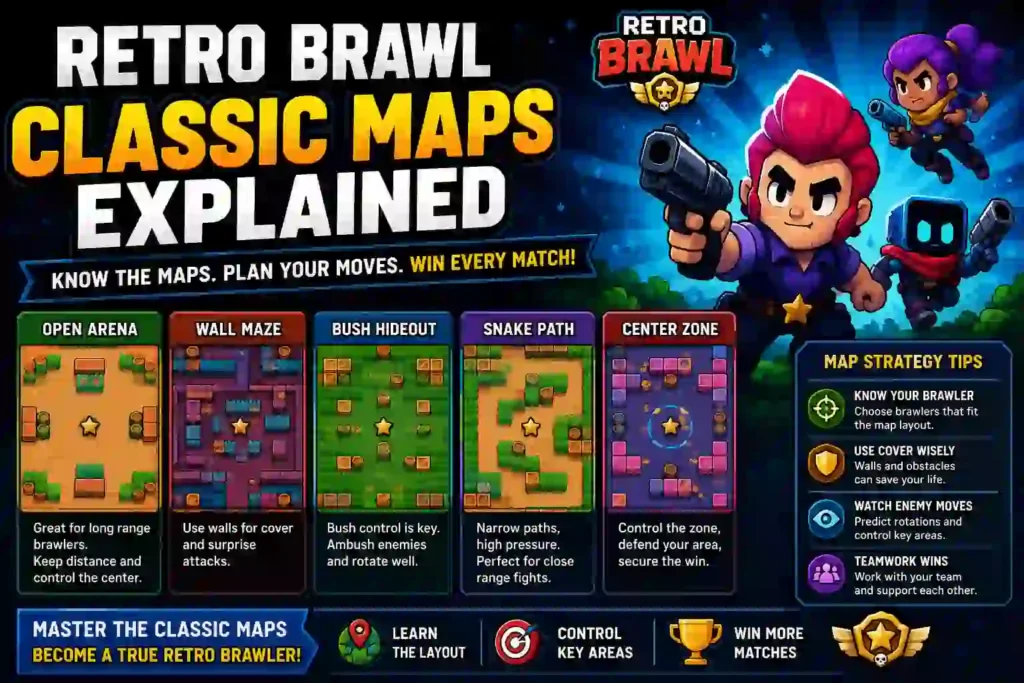
In this guide, I’ll discuss the main characteristics of Retro Brawl classic maps and provide advice on the best strategies for playing on them.
What Are Retro Brawl Classic Maps?
Classic maps are maps that focus on the gameplay revolving around a brawler of older design. The primary mechanics are the basic fundamentals of the game, not advanced ones.
Depending on the version of Retro Brawl or private server that you are playing, the set of the available maps and their layouts could differ. Some versions could have recreated or modified any of the previously existing maps.
The common themes and structures that could be found in most of them include walls, bushes, open lanes, narrow passages, central areas to fight, side passages, choke points, and objective zones. Since the set of available maps could vary from version to version, make sure to check what maps are available in your build of Retro Brawl.
Why Knowing the Map is Critical
Knowing the map gives critical advantages before the match even starts. It allows you to know where enemies could possibly be and where it is safe to attack them.
For example, if there is an open map, it would be a good idea to pick long-range brawlers. Meanwhile, a map full of walls and narrow passages would be more beneficial for close-range brawlers.
The following information about maps will help you in:
- Positioning,
- Dodging attacks,
- Attacking from advantageous positions,
- Pushing and occupying,
- Retreating,
- Picking brawlers.
Open Maps
An open map is a map that has a notable amount of space and, typically, fewer walls and other obstacles.
It means that there are extended open lines of sight on the map, making it possible to hit enemies from a distance.
Recommended Strategy
Stick to moving while attacking on open maps instead of being a sitting duck.
While long-range brawlers will have an advantage, the close-range brawlers could use the open map to their disadvantage if they don’t take any cover. Try to keep moving while attacking and use the edges of the map to your advantage. Whenever possible, keep a distance from close-range brawlers and keep an eye on their fire patterns.
Maps With Lots of Walls
Maps with lots of walls tend to have many short lines and provide more opportunities to take cover behind them.
Walls could be used to avoid attacks from enemies and get into a good position to attack.
Recommended Strategy
Use walls as a way to take short breaks from getting attacked. Try to pop out of the walls and attack when it is safe. It is critical to remember that walls on maps in Retro Brawl are not a solid defense. They only provide an opportunity to reposition.
Moreover, walls could allow enemies to get into close-range better than you, making it more dangerous.
Bush-Focused Maps
Bushes could be some of the most critical structures on the map, providing cover and allowing you to engage enemies unexpectedly.
If you are in a bush and an enemy is not, you have a considerable advantage. You could engage enemies from a bush or use it as a tool to reposition.
How to Use Bushes
You should never stay in the same bush for too long, as an experienced enemy will be able to check them every now and then.
Instead, you should use multiple bushes and always try to surprise enemies with your appearance. Check bushes before engaging or retreating, and try to never give away your position.
Most of the classic maps have central areas with choke points that become the focal points of many battles. These narrow areas are good places to attack, as the enemy has to walk through them to reach objectives. Moreover, these areas are dangerous as enemies could get engaged from unexpected directions.
Choke Point Strategy
If your brawler is good at fighting in close quarters, using choke points could be very rewarding. However, always remember to not get engaged by multiple enemies at once, as it could be safer to just run away and regroup with your allies instead.
Choosing the Right Brawler Based on the Map
The type of map directly impacts the selection of the brawler you should use. Below are the general rules of thumb for picking brawlers based on the map:
- Map Type
- Brawler Recommendation
- Open area
- Long-range
- Lots of walls
- Throwers / close-range
- Lots of bushes
- Close-range
- Lots of narrow passages
- Area control
- Mixed terrain
- Flexible brawlers
- Focus on objectives
Control / support
Depending on the game mode and your and your enemy’s brawlers, the most powerful brawlers could vary.
Classic Map Positioning Tips
The best tip for positioning on a map is to always stay near cover when possible. It is always better to engage enemies when you have the opportunity to take cover rather than being fully exposed.
Control Important Routes
Sometimes, trying to control important parts of the map is a better option compared to chasing enemies.
Don’t Crowd Your Team
If all of your team members are grouped together, a single enemy attack would be able to damage or eliminate multiple of them.
Instead, try to spread out, but keep a sufficient distance so that you can support each other.
Know Your Escape Route
Before committing to an engagement, always remember to know your escape route. It is especially important for brawlers that have low health.
Map Awareness Tips During a Match
Map awareness in Retro Brawl is all about knowing what is going on outside of the immediate combat. Try to track the following information during the match:
- Missing enemies,
- Enemy movements,
- Destroyed walls,
- Enemy’s special abilities,
- Bush movements,
- Objective position,
- Your team members’ positions.
If you see that an enemy is not in a place where you expect them to be, it is always better to assume that they are not there rather than the opposite.
Common Mistakes to Avoid When Playing on Classic Maps
1. Running Towards Enemies
Always try to avoid predictable movements.
2. Ignoring Cover
Always try to use cover if it is available, as open areas are dangerous.
3. Chasing Enemies Too Hard
Sometimes, a player could win a fight, only to lose the next one because they were chasing the enemy instead of letting the enemy come to them.
4. Paying Too Much Attention to Eliminating Enemies
Depending on the game mode, sometimes it is wiser to focus on the objective rather than enemies.
5. Standing Still
Even the best positions become predictable over time.
How to Practice Playing on Classic Maps
The best way to learn a map is to play on it for a long time. The first thing you should do is find three things on the map: the best safe positions to be in at all times, the best meeting points, and the best ways to retreat or approach enemies.
After you have played the map for several games, you could focus more on the tactical part: which spots allow you to attack the enemies the most and which provide the best defense.
You could also practice playing on different brawler types in order to see how a particular map feels with them.
Final Thoughts
Retro Brawl Classic Maps Explained is all about learning the fundamentals of map positioning in this game. Walls, bushes, open areas, narrow passages, and objectives all impact gameplay in unique ways.
Instead of memorizing a single strategy guide, I recommend learning how to adapt to the map: select brawlers that are strong on this map, use the advantages of the terrain, and always try to avoid unnecessary fights.
Since different builds of Retro Brawl could have different sets of maps, always make sure to refer to the maps in your build before trying to use advice from this guide. This way, you will ensure that your guide is relevant to your audience and not a single build’s maps.